University of Debrecen Expands International Relations Through Agriculture Collaboration with the State of Nebraska
The University of Debrecen has taken a concrete step toward widening its international relations, following high-level talks between university leadership and senior officials from the State of Nebraska in the United States. The meeting placed agricultural science, climate adaptation, and innovation at the center of a partnership that could shape research and education cooperation between Hungary and the American Midwest for years to come.
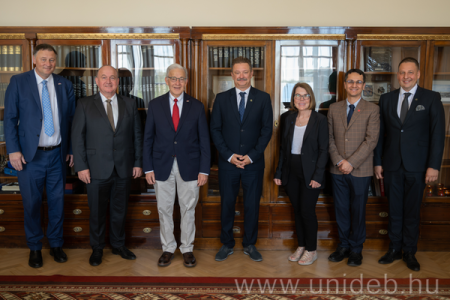
Zoltán Bács, Rector of the University of Debrecen, and Endre Harsányi, Vice Rector for Sectoral Development, met with Nebraska Secretary of State Robert Barnett Evnen, Deputy Secretary of State Cindi Allen, and László Búza, Hungary’s State Secretary for Food Economy, Distribution and Education at the Ministry of Agriculture and Food Economy. The shared agenda focused on expanding the university’s international network and identifying new educational, research, and innovation collaboration opportunities in the United States.
For prospective students, researchers, and agribusiness professionals, the announcement matters in practical terms. Partnerships of this kind translate into joint research projects, student and faculty mobility programs, and shared expertise in fields such as irrigation, plant breeding, and precision farming. If you are considering graduate study or research in agricultural sciences in Central Europe, explore the degree programs offered by the University of Debrecen’s Faculty of Agricultural and Food Sciences and Environmental Management to see how this new transatlantic link could influence your future study and mobility options.
Why the University of Debrecen and Nebraska Form a Natural Partnership
At first glance, a university in eastern Hungary and a state in the American Midwest may seem an unlikely pairing. In agricultural terms, however, the two regions have a great deal in common.
Nebraska ranks among the most productive agricultural states in the US, with large-scale corn and soybean production, a major livestock sector, and one of the most developed irrigation systems in the country. Hungary, and the region around Debrecen in particular, sits at the heart of the Great Hungarian Plain, one of Central Europe’s most significant agricultural zones.
Both regions now face strikingly similar pressures. Reporting on the meeting highlights increasingly frequent droughts, extreme temperatures, and growing uncertainty in precipitation distribution as shared challenges. These conditions raise the stakes for modern water management and sustainable agricultural solutions on both sides of the Atlantic.
Experts from the American and Hungarian delegations agreed that effective responses to these challenges should rest on knowledge-based collaboration and technological innovation rather than isolated national efforts. That consensus forms the practical foundation of the new partnership.
Inside the Talks: What Was Discussed and Why It Matters
The Nebraska delegation’s visit to Hungary was not a ceremonial exchange. According to Vice Rector Endre Harsányi, agricultural knowledge transfer and adaptation to climate change ranked among the top-priority topics of the discussions.
Talks with representatives of the State of Nebraska and with Saleh Taghvaeian, Associate Professor at the University of Nebraska-Lincoln, centered on cooperation models with tangible outputs: joint research projects, student and faculty mobility programs, and the mutual exchange of accumulated expertise in irrigation development, plant breeding, soil science, and precision farming.
For the University of Debrecen, the talks represent a deliberate strategy. The institution has invested steadily in agricultural research, and partnerships with established US agricultural states give its researchers and students access to complementary know-how, particularly in irrigation science and drought management, where Nebraska’s experience maps directly onto Hungarian conditions.
Five Focus Areas Set to Define the Agriculture Collaboration
With support from Hungary’s Ministry of Agriculture and Food Economy, the State of Nebraska and Hungarian partners plan to launch specific, practice-oriented cooperation projects in several strategic areas of agriculture.
Precision Farming
Precision farming uses sensor data, satellite imagery, and variable-rate technology to manage fields at a sub-field level. Nebraska’s large commercial operations and Hungary’s diverse farm structures both generate demand for research on how these technologies perform under different soil, climate, and economic conditions. Joint projects are well placed to deliver exactly that comparison.
Irrigation Development and Water Management
Water is the defining agricultural question of the coming decade in both regions. Nebraska’s decades of experience with large-scale irrigation, combined with Debrecen’s research into water-efficient cultivation, creates a natural exchange. Expect applied studies on irrigation scheduling, water-use efficiency, and drought response strategies.
Drought-Tolerant Plant Varieties
Breeding crops that maintain yields under water stress is a shared research priority on both continents. Joint variety trials and breeding programs could shorten the path from laboratory to field for new drought-tolerant varieties suited to continental climates like those in Hungary and Nebraska.
Soil Health Preservation
Soil degradation, erosion, and declining organic matter affect farms in both countries. Collaborative soil science can benchmark conservation practices, including cover cropping, reduced tillage, and nutrient management, across two very different farming systems, producing findings useful well beyond the two partner regions.
Agricultural Digitalization
Farm management software, remote sensing, and data-driven decision support form the digital backbone of modern agriculture. Cooperation in this area supports both research output and the development of practical tools that Hungarian and American producers can adopt in daily operations.
Interested in following how precision agriculture research develops in Central Europe? Monitor the University of Debrecen’s official news channels for announcements about joint projects, calls for research participation, and funding opportunities connected to the Nebraska partnership.
Student and Faculty Mobility: The Practical Opportunities
Research cooperation tends to attract headlines, but mobility programs often deliver the most immediate value to students and early-career academics. Based on the scope discussed during the talks, several formats are likely to develop over time:
- Semester exchanges: agricultural science students gaining coursework and field experience at partner institutions in Nebraska or Debrecen.
- Research placements: graduate students and doctoral candidates joining joint projects in irrigation, plant breeding, and soil science.
- Faculty exchanges: lecturers and researchers teaching, co-supervising theses, and co-publishing across the two institutions.
- Joint field programs: short, intensive study visits focused on irrigation districts, research farms, and precision agriculture operations.
Current and prospective students should treat these opportunities as emerging rather than fully established. Mobility frameworks typically take one to two years to move from agreement to funded exchange. The practical step now is to register interest early: contact the University of Debrecen’s international office, or your home institution’s mobility coordinator, and ask to be notified when calls for applications open.
Broader Benefits for Hungary’s Agricultural and Food Economy
The partnership extends beyond campus. Hungary’s Ministry of Agriculture and Food Economy is actively involved in strengthening the relationship, a signal that the collaboration carries national economic weight.
The initiatives aim to reinforce research and innovation partnerships while also opening new market opportunities for Hungarian agricultural and food industry players in Nebraska. For Hungarian food producers and agtech companies, a formal academic channel into a major US agricultural state can serve as a credibility marker and a route to commercial contacts that would otherwise take years to build independently.
This dual structure, combining research cooperation with market access, reflects a broader trend in Hungarian higher education, where universities increasingly operate as anchors of international economic and academic diplomacy.
What the Partnership Means for International Students Considering Hungary
The University of Debrecen is one of Hungary’s largest and most internationally oriented universities, hosting a substantial community of international students across English-language programs in medicine, engineering, natural sciences, and agriculture. For applicants evaluating study destinations, the Nebraska agreement strengthens three practical arguments for Debrecen:
- A growing international network: the university is demonstrably expanding its relationships with US institutions, which tends to generate scholarships, exchanges, and joint research options over time.
- Research-relevant programs: students in agricultural sciences study in a region where core research topics, including drought, irrigation, and soil health, are visible in the surrounding fields, not only in the laboratory.
- Strategic location and affordability: Debrecen offers a lower cost of living than Budapest while remaining Hungary’s second-largest city, with strong transport links and an established international student community.
Have questions about studying agricultural sciences in Hungary? Write to the University of Debrecen’s international admissions team to request details on entry requirements, tuition fees, and scholarship options, and ask specifically how the university’s US partnerships may affect your chosen program.
From Agreement to Implementation: What Happens Next
Announcements of this kind mark a beginning, not an endpoint. In practice, turning the Nebraska-Hungary framework into working programs will involve several predictable stages: negotiating specific project agreements, securing research funding on both sides, defining mobility quotas and credit recognition, and launching pilot projects in the five strategic areas outlined above.
Observers should watch for concrete markers of progress: the first joint publications, calls for student applications to exchange programs, and pilot irrigation or breeding trials conducted under shared protocols. The stated intention to keep projects practice-oriented suggests that field-level results, not only academic papers, will define success.
Planning ahead? If you intend to apply to an agricultural science program at the University of Debrecen with an eye on future mobility options, submit your application early in the admissions cycle. Competitive places in internationally connected programs tend to fill quickly, and early applicants are best positioned for scholarships and exchange selection.
A Measured but Meaningful Step for Hungarian-US Academic Relations
The University of Debrecen’s talks with the State of Nebraska will not reshape Hungarian agriculture overnight. But the combination of aligned climate challenges, complementary research strengths, active ministry support, and a clear focus on practical outcomes gives this partnership a stronger foundation than most ceremonial agreements.
For students and researchers, the message is straightforward: monitor developments, prepare documentation early, and position yourself for the mobility programs and joint projects expected to follow. For Hungary’s agricultural sector, the agreement opens a credible channel into one of America’s most important farming states at a moment when shared challenges, above all water scarcity, demand international solutions.
Are you a student, researcher, or agribusiness professional with experience of Hungarian-US academic cooperation? Share your perspective and questions in the comments below, and explore the University of Debrecen’s program pages to learn how its expanding international relations could fit your academic or professional plans.