
Study at the University of Debrecen: Education Opportunities in Hungary as the 112th Academic Year Begins
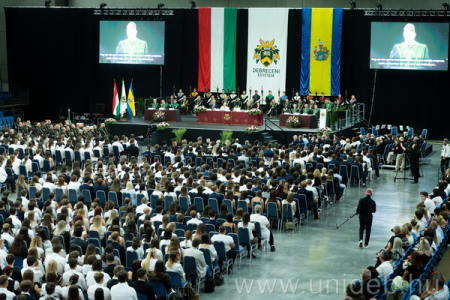
The University of Debrecen has officially opened its 112th academic year with a ceremonial senate meeting held at the Főnix Aréna in Debrecen, Hungary. More than 12,000 first-year students joined university leaders, faculty, and family members at the event, which combined long-standing academic tradition with clear signals about the institution’s future direction. For prospective applicants — especially international students evaluating education opportunities in Hungary — the ceremony offered concrete information about academic strengths, industry connections, campus life, and governance.
This article reviews the key announcements from the opening ceremony and converts them into practical takeaways for anyone considering an application to one of Hungary’s largest and most internationally oriented universities.
Ready to start researching? Explore the full range of degree programs at the University of Debrecen — from medicine and engineering to agricultural sciences, economics, and the humanities — to find the field that matches your background and career plans.
A New Academic Year in Hungary Opens With Record Momentum
The size of this year’s incoming class underscores the university’s appeal: more than 12,000 freshers are beginning their studies this September, one of the largest cohorts in the institution’s modern history. Rector Zoltán Bács opened his address by pointing to the symbolism of the ceremony’s venue. The Főnix Aréna takes its name from the phoenix, the mythical bird that repeatedly rises from its ashes and serves as the emblem of the city of Debrecen. According to the rector, the phoenix endures because each rebirth carries forward every value and experience gained before — a description he applied directly to the university itself.
Bács characterized the institution as one that takes pride in its traditions without living in the past. He emphasized that the university constantly renews itself and adapts to a changing world while protecting academic freedom and building operational models that provide stability and security for its students and staff.
One detail from the speech drew particular attention. The youngest student enrolled this academic year is 15 years old and recently passed his high school graduation examination with exceptional results in mathematics and physics. The rector used the example to make a point worth remembering during any application process: talent does not always conform to the usual timeline, and universities that recognize this open their doors to a broader range of capable learners.
Minister for Education and Children’s Affairs Judit Lannert reinforced the institution’s national significance. She stated that the future of Hungary is inseparable from the University of Debrecen and described it as a model for other institutions of higher education in the country.
Why International Students Choose the University of Debrecen
Hungary has become one of Central Europe’s most accessible destinations for international study, and the University of Debrecen has played a pioneering role in this development. Minister Lannert noted that the university’s multi-layered recruitment system — supported by an extensive partnership network, regional offices, and sustained international marketing — serves as a genuine example for other Hungarian universities.
Academic Range and Research Capacity
The university’s medical program is internationally renowned, and strong performance extends across engineering, agricultural sciences, social sciences, and the humanities. The scale of the institution supports this breadth: more than 2,700 researchers and faculty members work at the university, and it has signed cooperation agreements with 44 vocational training institutions across 12 sectors. For students, this translates into access to a wide choice of specializations, interdisciplinary projects, and applied research opportunities within a single institution.
Graduate Employment Outcomes
Minister Lannert also highlighted that the university occupies a prominent position in rankings that measure the employment prospects of graduates. This matters for any applicant comparing universities: employment outcomes are among the most reliable indicators of program quality and industry relevance. The close relationship between the university and major employers in the region — discussed in more detail below — helps explain these results.
Want the details? Review the admission requirements, tuition structure, and scholarship options for international students at the University of Debrecen well before application deadlines, since documentation requirements can take considerable time to complete.
Education Opportunities Beyond Lectures and Exams
Rector Bács addressed the incoming class directly, reminding them that every fresher arrives with a different story, a distinct set of experiences, and unique goals — and that the university now unites them all. He stressed that time spent at the university is not exclusively about sitting in lecture halls and taking exams. It is equally about establishing human connections, sharing experiences, and building lifelong friendships.
The campus environment supports this broader view of education. Bács listed the university’s active sports and cultural scenes, music and theater programs, festivals, student organizations, and community initiatives as core parts of the student experience. For international students in particular, these structures shorten the adjustment period and make daily life in Hungary easier to navigate.
Kevin Németh, President of the university’s Student Self-Government (HÖK), welcomed the freshers with a message about the university’s mission: to provide a solid foundation that enables students to adapt to new challenges. In his words, the university offers both knowledge that provides security and the freedom for everyone to find their own path — and the Student Self-Government will continue working so that every student can make the most of their college years.
Questions about campus life? Share your questions in the comments below, and explore our related guides on student housing, cost of living, and daily life in Debrecen.
Governance Renewal and Long-Term Institutional Stability
Behind the ceremony, the university also marked a structural transition. László Mátyus, the newly appointed chair of the Board of Trustees of the Count István Tisza Foundation for the University of Debrecen (GTIDEA), addressed attendees on behalf of the new board. He acknowledged that the challenges of the 21st century require refreshed thinking and operations, and stated that the university’s aim is not only to respond to these challenges but to become an initiator and shaper of them.
Mátyus outlined the board’s priorities: phasing out the current foundation and transitioning the university to a new governance model that ensures competitiveness and autonomy — both academic and operational. He committed the board to providing a stable, predictable, and development-friendly environment, adding that the unity of education, research, and innovation creates the values that strengthen the institution, the region, and Hungary in the long run.
For applicants, governance may seem like a distant concern, but it has direct consequences: funding continuity, campus investment, program development, and the stability of degree programs all depend on sound institutional management. The public commitment to autonomy and long-term development is therefore a relevant signal for anyone making a multi-year educational commitment.
Honoring a Legacy: New Emeritus Titles and University Awards
The ceremony also served to recognize outstanding contributions to the university’s reputation. For the first time in its history, the institution conferred the titles of rector emeritus and decanus emeritus, honoring former leaders whose work shaped the modern university.
Recipients of the rector emeritus title included leaders spanning the institution’s predecessor universities and the integrated University of Debrecen founded in 2000: Lajos Gergely and László Muszbek, both former rectors of the Medical University of Debrecen; György Bazsa, former rector of Kossuth Lajos University; László Fésüs, the first rector of the integrated university; Kálmán Győry, János Nagy, László Imre, and István Fábián. Professor András Nábrádi, a school-founding professor and former dean of the Faculty of Economics, received the decanus emeritus title.
Additional honors followed. The Senate awarded the University of Debrecen Medal of Honor to Rector Emeritus György Bazsa for more than six decades of professional and public service in higher education and Hungarian academic life. Professor Katalin Várnagy received the Pro Universitate Prize for her pioneering work in modern chemistry education and her research contributing to a better understanding of neurodegenerative diseases. Former rector Zoltán Szilvássy received the Pro Auditoribus Universitatis Debreceniensis Award from the Student Self-Government in recognition of decades of work on behalf of students.
The university also presented its Alumni Award to the BMW Group Plant in Debrecen, accepted by President and CEO Hans-Peter Kemser. His remarks captured the practical value of university-industry cooperation: “Factories are really built on people, not concrete and steel, which is why the best investment is always going to be to educate young people.” For students in engineering, informatics, and technical fields, this relationship signals genuine internship and employment pipelines connected to one of the region’s most significant industrial investments.
Practical Advice for Applicants to the University of Debrecen
What should prospective students take away from this year’s opening ceremony? Four concrete lessons stand out.
1. Start Your Research Early
Application processes for international programs — particularly in medicine — involve document collection, translations, entrance examinations, and visa procedures. Review program pages, deadlines, and requirements as early as possible, and prepare a checklist for each step.
2. Judge Programs by Outcomes, Not Marketing
Graduate employment rankings and formal industry partnerships, such as the university’s relationship with the BMW Group Plant Debrecen, provide measurable evidence of quality. Compare institutions on these concrete indicators rather than promotional language.
3. Weigh Community and Campus Life in Your Decision
The rector’s message about friendships, student organizations, festivals, and community initiatives is not decorative. Students who integrate socially are more likely to complete their degrees. Investigate the sports clubs, cultural programs, and student self-government support available on any campus you consider.
4. Keep Nontraditional Paths in View
The story of this year’s 15-year-old mathematics and physics student is a reminder that academic timelines vary. If you are a younger applicant, a career changer, or a mature student, examine whether your chosen institution offers flexible admission routes that recognize demonstrated ability.
Next step: Compile a shortlist of programs, note their application deadlines, and contact the admissions office with specific questions about your situation. Applying with complete, well-prepared documentation remains the single most effective way to improve your chances of admission.
Conclusion: Take the Next Step Toward Studying in Debrecen
The 112th academic year opening at the University of Debrecen combined ceremony with substance: a record-scale incoming class, internationally recognized programs — led by a renowned medical faculty — expanding industry partnerships, and a governance transition designed to protect institutional autonomy and long-term development. Rector Bács closed his address to the freshers by invoking the message of the phoenix: it is knowledge that empowers us to find the potential for renewal in every change.
For prospective students in Hungary and abroad, the practical conclusion is straightforward. Assess your goals, compare programs on evidence such as employment outcomes and research capacity, and prepare your application thoroughly.
Take the next step today: submit your application to the University of Debrecen, request detailed information about your chosen program, or schedule a free consultation to discuss your study plans with an advisor. Share this article with anyone considering education opportunities in Hungary, and explore our related articles for further reading on studying in Central Europe.