
University of Debrecen Earns International Recognition for Robotic Surgery Training in Hungary
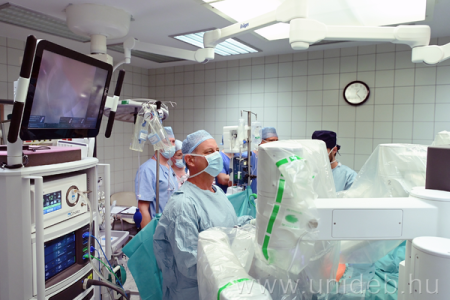
The University of Debrecen has reached a milestone that places its Clinical Centre among the recognized teaching sites for robot-assisted surgery. Zoárd Krasznai, director of the Department of Obstetrics and Gynecology, has been appointed as a proctor for the Da Vinci robotic surgical system — a formal certification that authorizes him not only to perform robot-assisted procedures but also to take part in the practical training of specialists from Hungary and abroad. The appointment serves as international recognition of the high standard of robotic gynecological surgery in Debrecen and of the consistent professional development achieved at the clinic in recent years.
For prospective medical students, early-career physicians, and healthcare professionals following surgical innovation in Central Europe, this development carries practical weight. It confirms that one of Hungary’s leading medical universities is not merely adopting advanced technology but has become qualified to teach it under the rigorous quality assurance framework that governs robotic surgery worldwide. This article explains what the appointment involves, how the robotic program developed, and what it means for anyone considering medical education in Hungary.
A Milestone for Robotic Surgery and Medical Education in Hungary
A proctor in robotic surgery carries responsibilities that go well beyond operating. When a hospital introduces a robotic surgery program, the equipment manufacturer delegates an experienced proctor to the site. That instructor’s principal task is to guarantee patient safety from the very beginning and to provide professional support to the operating surgeon until the surgeon gains the indispensable initial experience and confidence required to perform procedures independently at the console.
Dr. Krasznai has now moved from the supervised role to the supervisory one. Recently, a group of early-career professionals in robotic surgery from across Hungary observed him perform robot-assisted procedures at the University of Debrecen Clinical Centre. During the operations, he shared his professional experience and practical expertise, offering advice designed to help the participants conduct effective robotic surgical procedures on their own in the future.
This transition from trainee to trainer integrates Debrecen into an extensive international network. The Da Vinci system is used in thousands of clinical centres around the world, and proctors form the backbone of the structure that keeps surgical standards consistent across all of them. Joining that network as an educator indicates that the professional work performed in Debrecen meets the highest international expectations, under rigorous oversight and quality assurance.
Inside the Da Vinci Robotic Surgery Programme at the Clinical Centre
The scale of the program helps explain why the recognition matters. The Da Vinci robot-assisted surgical system has been in use at the Clinical Centre of the University of Debrecen since April 2024, and in that short time the institution has built substantial experience across multiple surgical fields.
- More than 160 robot-assisted procedures performed personally by Dr. Krasznai since the program launched.
- Approximately 1,200 robot-assisted procedures carried out at the institution overall since the equipment was introduced.
- Five surgical specialties rely on the system: general surgery, urology, gynecology, thoracic surgery, and otolaryngology.
That adoption pace is notable. It reflects both patient demand for minimally invasive treatment options and the Clinical Centre’s decision to integrate robotic technology across departments rather than confine it to a single specialty. For students and young doctors, this breadth means that exposure to robotic techniques is becoming part of the normal clinical environment rather than a rare spectacle reserved for a handful of experts.
Considering a medical career in an environment where modern surgical technology shapes everyday clinical practice? Explore the range of medical programs available at the University of Debrecen and evaluate which pathway matches your professional goals.
How International Recognition in Robotic Surgery Is Earned
Proctor status is not granted casually. As Dr. Krasznai explained in an interview with the university’s news service, earning the instructor role is subject to rather strict professional criteria. The requirements include:
- A vast number of completed surgical cases on the robotic system
- Extensive and complex surgical experience beyond the console
- Demonstrably reliable and good surgical outcomes
- Efficient performance combined with a low complication rate
All of these factors together formed the professional foundation that allowed Dr. Krasznai to take an active part in the practical training of robotic surgery. The logic behind the requirements is straightforward: a proctor’s first duty is patient safety. Before any surgeon is entrusted with training others, the system’s operators need documented evidence that his or her results are consistently sound. This is why the appointment functions as a quality label — it verifies outcomes, not just activity.
What the Appointment Means for the University of Debrecen and the Region
Professor Zoltán Szabó, president of the Clinical Centre of the University of Debrecen, framed the appointment as confirmation of sustained institutional development. Under Dr. Krasznai’s leadership, obstetric and gynecological care has developed dynamically from a professional standpoint and has stood at the forefront of introducing innovative procedures, to the point where the department now operates as a patient care centre of European standards.
According to Professor Szabó, state-of-the-art technologies, innovation, and top-quality patient care have been organically integrated under Dr. Krasznai’s direction. He also emphasized the wider significance: the recognition of professional excellence strengthens the international reputation not only of the institution but of the entire region and the Hungarian healthcare system as a whole.
For the university, the practical benefits are concrete. Proctor status means visiting specialists, incoming training cases, and a seat at the table where international surgical standards are set and maintained. For patients in eastern Hungary, it means local access to advanced procedures that previously required travel to larger centres abroad. For students, it means learning from teachers who are actively shaping the field they instruct in.
Opportunities for Students and Early-Career Doctors in Medical Education
Observation and Structured Mentorship
The recent training session in Debrecen illustrates a model that benefits early-career professionals directly. Rather than learning robotic techniques solely through trial and error, young surgeons observed a certified expert operate in real time, asked questions, and received targeted feedback. This kind of structured mentorship shortens the learning curve at precisely the stage where errors carry the highest cost.
Exposure Across Multiple Specialties
Because the Da Vinci system in Debrecen is used in general surgery, urology, gynecology, thoracic surgery, and otolaryngology, students and residents encounter robotic methods in several clinical contexts. Familiarity with robot-assisted workflows is increasingly relevant for residency applications and fellowships, as hospitals across Europe and North America continue to expand their robotic programs and seek candidates with console experience.
Have questions about medical education in Hungary or about how clinical training works at Hungarian universities? Write to us — we are happy to help.
Why Hungary Remains a Strong Choice for Medical Studies
Hungary has built a long tradition of international medical education. Universities such as the University of Debrecen offer full degree programs in English, attracting students from dozens of countries. Degrees earned at Hungarian medical universities are recognized across the European Union, which opens pathways to residency and specialist training throughout Europe.
Three practical advantages stand out for international applicants:
- Clinical exposure at teaching hospitals. Programs are tied to university clinical centres, meaning students observe and participate in real patient care — including, increasingly, advanced procedures such as robot-assisted surgery.
- An international academic community. Large cohorts of international students create a multicultural learning environment supported by dedicated international relations offices.
- Value for money. Tuition fees and living costs in Hungary remain moderate compared with Western European or North American alternatives, without a corresponding sacrifice in training quality — a point reinforced by recognitions such as the one described here.
The appointment of a Debrecen surgeon as a certified robotic surgery proctor adds a specific, verifiable data point to the general case for studying in Hungary. It shows that the institution’s clinical staff are not only keeping pace with international practice but are being asked to teach it.
Lessons for Medical Professionals Building a Robotic Surgery Career
The path that led Dr. Krasznai to proctor status offers a useful template for surgeons aiming at a robotic subspecialty. The sequence is visible in his own account: establish broad surgical competence first, accumulate a high case volume on the robotic system, maintain documented outcomes with a low complication rate, work efficiently, and then pursue certification. There is no shortcut in that list. The manufacturers who grant proctor status verify each element before granting the credential.
For department heads and hospital administrators, the Debrecen example also shows how a robotic program grows: introduce the system with manufacturer support, concentrate cases to build experience quickly, expand across specialties once the core team is secure, and use certification as an external benchmark of quality. Consistent execution over years — not the purchase of equipment alone — produced this result.
Studying Medicine at the University of Debrecen: Practical Next Steps
Applicants interested in the University of Debrecen’s medical programs should prepare early. Admission typically requires a strong secondary school record in the sciences, an entrance examination covering biology and related subjects, and proof of English proficiency. Application windows and deadlines vary by intake, so reviewing the university’s official admissions information well in advance is essential.
Submit your application today if you are ready to begin your studies, or schedule a free consultation with an admissions advisor if you need help assessing your eligibility and preparing your documents.
Final Thoughts on Robotic Surgery and Medical Education in Hungary
The appointment of Zoárd Krasznai as a robotic surgery proctor is a personal professional success, but its significance extends much further. It validates the quality of robotic gynecological surgery at the University of Debrecen, connects the institution to an international network of certified teaching centres, and strengthens the reputation of Hungarian medical education as a whole. With roughly 1,200 robot-assisted procedures performed since April 2024 and the system now in use across five specialties, Debrecen has demonstrated that sustained investment in technology and people produces internationally recognized results.
For students choosing where to study medicine, and for young doctors deciding where to complete their training, the case offers a clear signal: institutions that commit to innovation create stronger learning environments. Share your experiences or questions in the comments below, and explore our related articles on studying medicine and healthcare innovation in Europe for further reading.