University of Debrecen Welcomes Hand‑Woven Silk Carpet from Long‑Standing Iranian Partners
Celebrating More Than Three Decades of Academic Collaboration
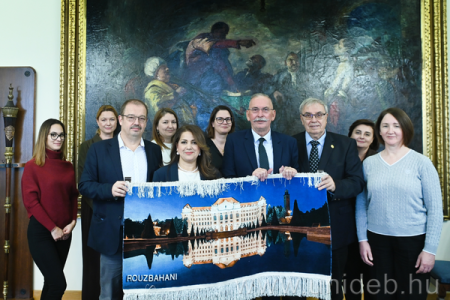
The University of Debrecen received an impressive handmade silk carpet at a formal ceremony held at the university’s main campus. The artwork, created by artisans in Iran, depicts the university’s emblem and architectural elements that have become familiar to students and staff across the years. The present was donated by the Rouzbeh Scientific Institute, an organization that has supported the recruitment and integration of Iranian students for over 35 years.
What the Gift Signifies Beyond Aesthetic Value
Gift-giving is a long‑established custom in Iranian culture, especially when it comes to expressing gratitude for long‑term relationships. The silk carpet is therefore more than a decorative object; it is a tangible acknowledgment of the quality of the partnership and a promise of sustained cooperation. In the words of the institute’s head, “The carpet is a farewell gesture and a farewell to my work – I want to express my thanks to the university with a souvenir that will last.”
Design Highlights that Connect Two Worlds
- Patterned with intricate motifs that mirror the university’s architectural details.
- Embossed with the university’s name in both Hungarian and Persian script.
- Crafted from high‑quality silk fibers that last generations when properly cared for.
Rouzbeh Scientific Institute: A Case Study in Institutional Partnership
Founded in the 1980s, the Rouzbeh Scientific Institute has become one of the University of Debrecen’s most reliable partners in the field of international student recruitment. Their approach combines rigorous selection criteria for academic performance with a strong focus on cultural integration. This dual emphasis has been credited with the high retention rates observed among Iranian students enrolled at the university.
Key Milestones of the Partnership
- 1990 – First batch of Iranian students arrives, guided by the institute’s dedicated support team.
- 2005 – The institute expands its services to include assistance with visa applications, housing, and language courses.
- 2015 – Joint research collaborations commence between Hungarian faculty members and Iranian scholars.
- 2020 – The institute’s alumni network surpasses 1,200 members who have successfully completed their studies in Hungary.
- 2023 – The University of Debrecen publicly acknowledges the institute’s contribution at the annual International Relations symposium.
Impact on the Student Body: Numbers Speak for Themselves
Currently, the university hosts 317 Iranian undergraduates. However, when the numbers are aggregated with alumni, the joint community exceeds 7,600 individuals. This figure places the University of Debrecen among the top European destinations for Iranian students seeking higher education beyond the health sciences – a field that accounts for roughly 60 % of the group, with a growing interest in natural sciences and engineering.
Personal Stories that Illustrate Support Structures
After a 15‑year partnership, graduates like Amir M., who earned a Ph.D. in plant biology, attest that the institute’s hands‑on assistance was instrumental in navigating the international admissions process as well as daily life in Hungary. Faculty member Prof. László Balogh notes that Iranian students often seek guidance on research ethics and compliance with university regulations, both areas where the institute roles prominently.
How the Silk Carpet Enhances the Cultural Landscape of Campus Life
The carpet will be displayed in the university’s main hall, where it serves as a point of conversation among visitors and a reminder of the university’s openness to global perspectives. Installation also includes a plaque that states the dedication of the Rouzbeh Scientific Institute and outlines the scope of the partnership’s initiatives. Students attending orientation will meet the institute’s liaison at the event to discuss ongoing support services.
Incorporating International Perspectives into Academic Programs
One of the University of Debrecen’s strategic goals is to integrate international viewpoints into its curricula. The presence of a cultural artifact such as this carpet signals the institution’s genuine commitment to cultural diversity. As a result, elective courses in international relations, cross‑cultural communication, and comparative literature are added to the schedule, providing students with broader learning opportunities.
Future Outlook: Sustaining Momentum in Student Exchange
The university and the Rouzbeh Scientific Institute have set a new target: to increase the number of Iranian students by 15 % over the next five years. This target aligns with Hungary’s national policy of attracting talent from the Middle East. The following actions will be prioritized:
- Expansion of scholarship programs to cover tuition and living expenses for high‑achieving Iranian applicants.
- Organizing joint workshops on research funding, especially in life sciences, where Hungarian and Iranian scholars frequently collaborate.
- Creating cultural exchange days where Iranian faculty present their research to Hungarian audiences.
- Streamlining visa assistance through digital platforms that reduce application processing time.
Student Voice: Feedback and Continuous Improvement
Annual surveys administered by the Coordinating Center for International Education capture students’ experiences and identify improvement areas. The survey results will inform the design of future orientation modules, ensuring that newcomers feel supported from day one.
Take Action: How You Can Involve Yourself in the University’s International Mission
- Submit your application today to explore international academic pathways at the University of Debrecen.
- Schedule a free consultation to learn more about admission requirements and available scholarships for Iranian students.
- Share your experiences in the comments below – your story might help future international students feel welcomed.
- Explore our related articles for further reading on cross‑cultural academic collaborations.
Closing Thoughts
The hand‑woven silk carpet, presented by the Rouzbeh Scientific Institute, is more than a decorative piece; it embodies the shared vision of two institutions committed to educational excellence and cultural humility. As the University of Debrecen continues to welcome young minds from the Middle East, the partnership offers a model for successful international collaboration that benefits scholars, faculty, and the broader academic community alike.