
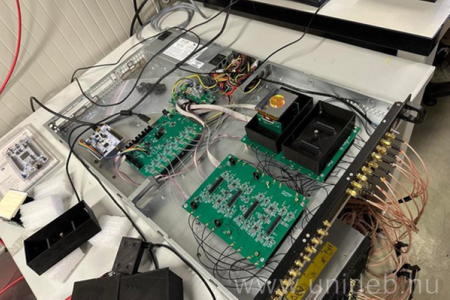
Innovative Detector Technology Bridges Physics Research and Medical Applications
Researchers at the University of Debrecen and HUN-REN ATOMKI have developed a groundbreaking detector technology with dual applications in fundamental physics research and practical medical solutions. This crystal-SiPM-based detector represents a significant advancement in precision measurement capabilities, demonstrating how basic research can drive innovation across multiple scientific disciplines.
The Challenge of High-Luminosity Particle Collisions
At CERN’s High-Luminosity Large Hadron Collider (HL-LHC), physicists face unprecedented challenges in analyzing particle collisions. The increased collision intensity creates overlapping signals that conventional detectors struggle to separate. The University of Debrecen’s detector technology addresses this critical need through exceptional temporal resolution capabilities.
The Role of High-Precision Time-of-Flight Detectors
The research team’s crystal-SiPM-based detector achieves several key advancements:
- Picosecond-level temporal resolution for event separation
- Accurate identification of charged particles
- Improved reconstruction of particle trajectories
- Enhanced detection of subtle physical phenomena
Through rigorous testing with particle beams and picosecond lasers, the team established reproducible characterization methods for detector response. These developments enable more precise analysis of simultaneous particle collisions than previously possible.
From Particle Collisions to Patient Care
The detector’s medical imaging applications demonstrate its transformative potential beyond physics research. Assistant Professor Balázs Ujvári, project leader at the Faculty of Informatics, explains how this technology translates to healthcare improvements:
- Increased image contrast in diagnostic imaging
- Reduced radiation exposure for patients
- Improved temporal resolution in scanning systems
- Enhanced detection capabilities for early disease diagnosis
“Our measurements show how fundamental research directly benefits practical applications. The same temporal precision needed for particle physics experiments can revolutionize medical imaging quality and safety,” Ujvári states.
Collaborative Research Driving Technological Innovation
This interdisciplinary project highlights the University of Debrecen’s strength in collaborative research. Supported by the National Research, Development and Innovation Office (project ID: 2021–4.1.2–NEMZ_KI–2024–00045), the work exemplifies how academic partnerships can accelerate technological development.
The Department of Data Science and Visualization’s involvement underscores the growing importance of computational methods in experimental physics. Researchers combined advanced simulations with physical testing to optimize detector performance and identify future development directions.
Future Applications and Research Directions
As detector technology continues to evolve, the University of Debrecen team is exploring several promising avenues:
- Adaptation for compact medical imaging devices
- Integration with artificial intelligence for data analysis
- Development of next-generation particle detectors for CERN experiments
- Potential applications in security scanning and materials science
Educational Opportunities in Cutting-Edge Physics Research
The University of Debrecen offers specialized programs for students interested in detector technology and applied physics:
- Bachelor’s and Master’s degrees in Physics with specialization in experimental techniques
- Research opportunities through the Faculty of Informatics and collaborations with ATOMKI
- International partnerships with leading research institutions like CERN
Submit your application today to join this innovative research environment and contribute to groundbreaking scientific discoveries.
Why Choose the University of Debrecen for Physics Research?
Students and researchers benefit from several unique advantages:
- State-of-the-art laboratory facilities for detector development
- Active participation in international projects like CERN’s HL-LHC program
- Interdisciplinary collaboration between physics, informatics, and medical research departments
- Strong industry partnerships for technology transfer
Have questions about our physics programs or research opportunities? Contact our admissions team to learn how you can participate in transformative detector technology development.
Impact on Hungary’s Scientific Landscape
This research positions Hungary at the forefront of detector technology innovation. The University of Debrecen’s contributions demonstrate:
- Hungary’s growing role in international physics collaborations
- The economic potential of translating basic research into commercial applications
- Opportunities for Hungarian students to engage with cutting-edge global research
- Strengthened partnerships between academic institutions and research centers
Explore our related research initiatives to discover how Hungarian scientists are addressing global scientific challenges.
Next Steps in Detector Technology Development
As the University of Debrecen continues to refine its detector systems, researchers emphasize the importance of sustained investment in fundamental research. The team’s success illustrates how theoretical investigations can yield practical technologies with broad societal benefits.
Schedule a consultation with our research department to discuss collaboration opportunities or learn more about our detector technology projects.