
University of Debrecen Advances Precision Agriculture and Water Management Through U.S. Collaboration
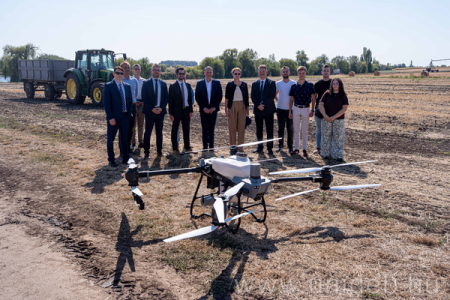
When a senior American diplomat walks through an experimental crop field in eastern Hungary, it signals far more than diplomatic courtesy. Caroline Savage, Chargé d’Affaires ad interim at the U.S. Embassy in Budapest, and Gellért Gólya, agricultural attaché, recently visited the Látókép Crop Production Experimental Station of the University of Debrecen to examine how precision agriculture, water management, and international research collaboration are reshaping farming in both countries. Rector Zoltán Bács and Endre Harsányi, Vice Rector for Strategic Development, welcomed the delegation and presented the university’s educational and research achievements in agricultural science.
For prospective students, researchers, and agribusiness professionals, the visit offers a clear message: the University of Debrecen has positioned itself as a serious international hub for precision agriculture, and its partnership with American institutions continues to expand. If you are considering a career at the intersection of agriculture and technology, explore the precision agriculture engineering program at the University of Debrecen and evaluate whether its dual degree pathway with a U.S. university fits your academic and professional goals.
Why Water Management Now Defines Hungarian Agriculture
Hungary’s recent summers have delivered a blunt lesson in climate reality. Repeated droughts have reduced yields, strained irrigation infrastructure, and forced farmers to reconsider how every drop of water is used. Rector Zoltán Bács addressed this directly during the delegation’s visit, noting that water scarcity poses an increasingly serious challenge worldwide and that efficient water management has moved to the forefront of agricultural priorities.
This is not an abstract policy debate. For a Hungarian arable farmer, the difference between a drought-resilient operation and a struggling one often comes down to decisions about when to irrigate, which crop varieties to plant, and how to read soil and weather data before committing resources. Those decisions increasingly depend on sensors, satellite imagery, and analytical models rather than tradition alone. Universities that teach these methods, and test them under real field conditions, produce graduates who can step into this changing environment with practical competence.
Water management is also where Hungarian and American agricultural interests converge most clearly. The Great Plains of the United States and the Carpathian Basin share a continental climate marked by periodic drought, variable rainfall, and pressure on groundwater resources. Research questions that matter in South Dakota or Nebraska matter almost identically in Hajdú-Bihar county. That shared challenge is the foundation of the partnership described during the delegation’s visit.
Inside the Látókép Experimental Station: Decades of Field Science
The Látókép facility, formally known as the Remote Sensing Crop Production Experimental Station, has served for several decades as one of Hungary’s key sites for crop production and water management research. Its value lies in continuity. Long-term field trials allow scientists to observe how land use decisions, fertilization strategies, and changing weather patterns interact across many growing seasons, something no laboratory simulation can fully replicate.
Current research at the station focuses on the agricultural impacts of climate change, land use, and water management. In practical terms, that means monitoring how crops respond to stress, measuring the efficiency of irrigation systems, and developing evidence-based recommendations for land use that farmers and policymakers can actually apply. Endre Harsányi, Vice Rector for Strategic Development and Head of the Department of Agricultural Machinery and Robotics, emphasized that the goal of the visit was to present a comprehensive overview of the university’s work in precision agriculture and climate research.
For students, access to a station of this scale is a genuine advantage. Rather than learning precision agriculture exclusively from slides and textbooks, students at the University of Debrecen test instruments, collect field data, and interpret results on working farmland. That experience matters when employers evaluate candidates for roles in agronomy, farm management, agricultural technology, and environmental consulting.
How U.S. Collaboration Powers Research and Teaching at Debrecen
The centerpiece of the university’s American partnership is its joint precision agriculture engineering program with South Dakota State University, which offers students a dual degree. According to Rector Bács, the university is now preparing further collaborations with additional U.S. universities in the areas of student exchange, scholarships, and joint research programs, and the delegation’s visit served as an opportunity to showcase achievements to date.
The logic of the partnership is straightforward. As Vice Rector Harsányi explained, Debrecen’s experts conduct parallel research with teams at South Dakota State University and Nebraska State University, using the same technologies, because all three institutions face similar climatic challenges. Parallel design means results can be compared directly across continents, strengthening the scientific validity of findings on both sides of the Atlantic.
Equally important is the transmission of this knowledge to the next generation. Harsányi stressed that existing expertise must be passed on so students can continue these studies at a higher level, with an even greater focus on precision, evidence-based land use and water management. In other words, the collaboration is not a one-off project but a pipeline: joint research informs joint curricula, and joint curricula produce graduates equipped to work in an internationalized agricultural sector.
Researchers, doctoral candidates, and industry partners interested in transatlantic projects can contact the Faculty of Agricultural and Food Sciences and Environmental Management to ask about current exchange schemes, scholarship options, and cooperative research initiatives built on these partnerships.
The Technology Students Actually Use: Drones, AI, and Precision Irrigation
Chargé d’Affaires Savage highlighted the practical core of the cooperation: students at the University of Debrecen work with U.S.-developed precision irrigation systems, drones, and artificial intelligence to produce more food while using less water. At a time when Hungary faces increasingly severe droughts, she noted, the collaboration gives Hungarian farmers access to advanced American expertise and technologies, while the United States gains a strong partner in strengthening global food security.
Understanding what these tools do helps clarify why this training matters:
- Drones and remote sensing: Aerial platforms capture multispectral imagery that reveals crop stress, disease outbreaks, and irrigation gaps long before they are visible from the ground, enabling targeted intervention instead of uniform treatment.
- Precision irrigation systems: Sensor-driven scheduling applies water according to actual soil moisture and crop demand, cutting waste and reducing the environmental footprint of production.
- Artificial intelligence: Algorithms integrate weather forecasts, historical yield maps, and real-time field data to support decisions on planting, fertilization, and harvest timing.
These are not speculative technologies reserved for large industrial farms. Equipment costs continue to fall, and national and EU funding programs increasingly support adoption. Graduates who can operate, calibrate, and interpret data from such systems enter the labor market with skills in measurable demand.
Skills That Transfer Beyond the Farm
A degree built around drones, sensors, and data analysis opens doors well outside traditional agronomy. Graduates of precision agriculture programs move into agricultural technology companies, remote sensing services, irrigation engineering, food supply chain analytics, and public sector roles in environmental monitoring. The problem-solving habits formed at an experimental station, where hypotheses must survive contact with real weather and real soil, are exactly what employers in these sectors look for.
What the Delegation Visit Means for Prospective Students
During the visit, the American delegation met directly with third-year precision agriculture engineering students from the Faculty of Agricultural and Food Sciences and Environmental Management. That meeting illustrates something worth weighing when you compare universities: the program’s international connections are active and visible, not decorative. Students had the opportunity to discuss their work with senior representatives of a partner country’s embassy, an experience that reflects the program’s diplomatic and commercial significance.
If you are evaluating study options in agricultural science, use the Debrecen model as a benchmark. Ask whether the programs you are considering offer:
- Access to an operating experimental farm or research station with long-term field trials.
- Formal dual degree or exchange agreements with universities abroad, particularly in countries with comparable research agendas.
- Hands-on training with current technology, including drones, sensor networks, and AI-based decision tools.
- Faculty who publish on climate change adaptation, land use, and water management, not only teach from textbooks.
- Clear scholarship pathways for international students.
Ready to take the next step? Review the admission requirements for the precision agriculture engineering program and submit your application before the next enrollment cycle closes. Early applicants typically have the widest access to housing, scholarships, and orientation support.
Five Practical Steps to Build a Career in Precision Agriculture
The developments at Látókép suggest concrete actions for anyone planning a career in this field:
- Build data literacy early. Courses in statistics, GIS, and basic programming will compound in value throughout your studies and career.
- Seek field experience every year. Volunteer for plot work, irrigation trials, or drone flights. Practical hours distinguish candidates in interviews.
- Follow water management research specifically. As drought pressure grows across Europe and North America, specialists who understand irrigation efficiency and drought-tolerant cropping will remain in demand.
- Use international networks deliberately. Attend guest lectures, join exchange programs, and maintain contact with researchers at partner institutions on both continents.
- Connect your thesis or capstone project to a real problem. The most persuasive early-career credentials demonstrate that you can apply precision tools to a genuine agronomic question.
If you are unsure which pathway within agricultural science suits your background, schedule a consultation with the university’s admissions or international office. A short conversation can clarify which track, whether engineering, plant science, or environmental management, aligns best with your prior education.
A Working Model of International Agricultural Cooperation
The visit by the U.S. delegation to the Látókép Experimental Station condensed a larger story into a single afternoon: Hungary and the United States face similar climatic pressures, deploy similar technologies, and benefit from training engineers who can work across borders. Savage summarized the cooperation as real technologies, practical solutions, and tangible results, a description that applies equally well to what students experience in the program itself.
For Hungary, the partnership strengthens food security and drought resilience at home. For the United States, it builds a capable European partner in global agricultural research. For students, it offers a credential backed by two university systems and hands-on access to the tools now defining modern farming.
Have questions about studying precision agriculture in Hungary or about the dual degree arrangement with South Dakota State University? Write to the University of Debrecen’s international admissions team for detailed guidance. And if you have studied or worked in precision agriculture, share your experiences in the comments below; your perspective can help the next cohort of students make informed choices. For further reading on agricultural research, study-abroad pathways, and emerging farm technologies, explore our related articles.