
From Ideas to Working AI Solutions: Inside the University of Debrecen’s DEIK.AI Student Competition
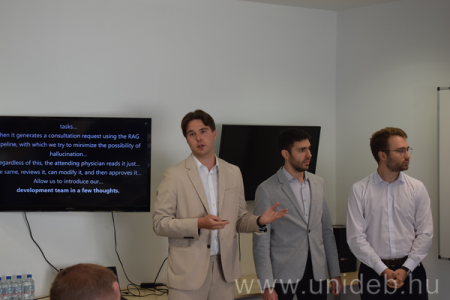
Artificial intelligence no longer belongs exclusively to computer science departments. At the University of Debrecen in Hungary, that principle has moved from statement to practice. The DEIK.AI Challenge 2026, a multi-stage student competition organized by the Faculty of Informatics with support from the Innovation Ecosystem Center, drew entries from students of medicine, engineering, health sciences, humanities, and the natural sciences, alongside informatics majors. The opening stage, the AI Idea Competition, attracted 43 submissions and closed with a final round in which twenty teams presented their concepts to an expert jury in person. This article examines how the competition is structured, what the winning projects reveal about current directions in AI, and what students hoping to compete in future editions can take away from the format.
A Student Competition Open to Every Discipline
The entry figures tell the story on their own. Of the 43 submissions to the AI Idea Competition, 33 came from individual students and 10 from teams. Participants included students not only from the Faculty of Informatics but also from engineering, health sciences, humanities, natural sciences, and medicine. Each submission had to present an AI-based concept offering an innovative solution to a real-world problem, either within a specific field or across several disciplines at once.
That breadth is deliberate. As artificial intelligence spreads into diagnostics, logistics, agriculture, education, and public services, the people best positioned to identify problems worth solving are often not programmers but practitioners in those fields. A medical student sees gaps in clinical documentation; an agriculture student sees inefficiencies in crop monitoring; a humanities student sees accessibility barriers in digital archives. A student competition that welcomes all of them converts scattered domain knowledge into concrete AI solutions.
Students weighing a future in informatics or applied AI can explore the programs offered by the Faculty of Informatics at the University of Debrecen, where coursework connects directly to innovation programs of this kind and where competition experience is treated as part of professional development.
How the AI Idea Competition Finals Worked
Twenty proposals advanced from the preliminary evaluation to the finals, hosted at the Faculty of Informatics. Each finalist faced a strict format: a three-minute pitch delivered in person to a jury, covering the essence of the idea, its purpose, and its expected practical applicability. Three minutes is unforgiving. It strips away filler and forces competitors to answer the only questions that matter early: what problem does this solve, for whom, and how?
What a Three-Minute Pitch Demands
The pitch format offers a lesson for any student preparing to present a technical idea. A strong short pitch typically follows a simple sequence: name the problem in one sentence, describe the AI solution in two, and close with a concrete example of where it would be used. Competitors who spend their limited time on technical architecture tend to lose the jury; those who lead with the problem and its practical application hold attention. Preparing for questions afterward matters just as much, since juries usually probe the assumptions behind a concept rather than the concept itself.
The Dean’s Case for Campus-Wide AI Engagement
András Hajdu, dean of the Faculty of Informatics, framed the competition’s purpose in broad terms. One of the initiative’s most important goals, he noted, is to give as many University of Debrecen students as possible the chance to present ideas related to artificial intelligence. AI, in his view, is no longer limited to computer science: it creates new opportunities for research, development, and innovation in nearly every academic discipline. The competition serves as a forum where those ideas can be showcased, receive professional support, and, critically, where students from different disciplines can connect with one another.
Hajdu also set expectations for what should follow the event. Promising initiatives, he emphasized, should not end when the competition does. The organizers view the challenge as a starting point for further development, research collaborations, participation in international competitions, or even future startups. That framing matters for students choosing where to study: a competition designed as the first stage of a longer pipeline signals institutional commitment well beyond a single event on the academic calendar.
Matchmaking: Where Idea Generators Meet Developers
One of the most practical elements of the DEIK.AI Challenge ran alongside the competition itself. The faculty linked a matchmaking initiative to the event, allowing idea generators who needed an IT developer to bring their concepts to life and present them directly to students. Ten idea generators used the opportunity, and nearly sixty students from the Faculty of Informatics expressed interest in serving as developers in response.
The imbalance is instructive. It suggests that many students hold concepts they cannot yet build, while many technically skilled students are looking for meaningful projects to apply their abilities to. Formal matchmaking closes that gap and, in the organizers’ assessment, represents an important step toward strengthening multidisciplinary collaboration across the university. It also mirrors how early-stage startups actually form: a founder with domain insight partners with a builder, and the project moves forward only when both sides commit.
For readers with an AI concept but no technical background, the model offers a clear path: write the idea down in plain language, define the problem and the intended user, and look for collaboration opportunities at your own institution or within student innovation communities.
The Winning Projects and What They Signal
The top three places in the idea competition went to Verified Clinical Reasoning, We.Save.It.AI, and GreenMind AI. Even from the names alone, the direction is clear. Verified Clinical Reasoning points toward healthcare, an area where AI-assisted decision support is under intense scrutiny and where verification of AI outputs is a live research question. We.Save.It.AI suggests resource conservation or efficiency, and GreenMind AI points to environmental sustainability, two themes that dominate both European research funding priorities and student-led innovation.
The pattern across the winners reflects a broader trend in student AI work: the strongest projects rarely showcase novel algorithms. They apply established techniques to problems the students understand intimately, whether from clinical placements, coursework in sustainability, or daily life. That is precisely what a multidisciplinary entry field is designed to produce.
From Ideas to Working Solutions: The Demo Competition and AI Sprint
The organizers structured the DEIK.AI Challenge as a progression rather than a single event. The next phase, the AI Demo Competition, accepts submissions of AI solutions, whether fully functional or in an advanced stage of development, with enhanced versions of projects from the idea stage explicitly eligible to enter. Top-performing demo projects receive invitations to the AI Sprint on October 9–10, an intensive development environment where selected teams continue building with focused support.
This staged design addresses a familiar failure mode in student competitions: promising concepts that stall once the certificates are handed out. By requiring a demonstration of working software in stage two and sustained development in stage three, the challenge pushes participants from ideation toward deployable AI solutions. Students interested in joining future cycles of the challenge should watch for the next call for submissions and start preparing a demo-ready prototype now, since an idea alone rarely wins at the highest level, but a working prototype, however rough, changes the conversation entirely.
Practical Lessons for Aspiring AI Competitors
For students considering entering an AI competition, whether at the University of Debrecen or another institution, the 2026 edition offers several transferable lessons:
- Start with a problem you have witnessed firsthand. Domain insight is harder to replicate than technical skill, and juries reward authentic problem understanding.
- Build a cross-disciplinary team early. The competition’s own matchmaking initiative exists because the strongest projects combine domain knowledge with development capability.
- Rehearse under time pressure. A three-minute pitch rewards preparation; practice until the problem, solution, and application fit comfortably within the limit.
- Plan past the deadline. Know what you would do with a win: further development, research collaboration, or a startup attempt. Competitions act as springboards only for teams with a plan.
- Treat every stage as iteration. The DEIK.AI Challenge explicitly allows enhanced versions of idea-stage projects into the demo round, and the same logic applies to your own work between events.
Have questions about studying informatics or artificial intelligence in Hungary? Contact the University of Debrecen’s international admissions team to learn about program options, application timelines, and scholarship opportunities.
Why the University of Debrecen’s Approach Stands Out
Several features distinguish this student competition from the typical hackathon. First, the scale of cross-faculty participation, with entries spanning medicine, engineering, health sciences, humanities, natural sciences, and informatics, reflects an institutional strategy rather than a single department’s outreach. Second, the Innovation Ecosystem Center’s involvement signals that the university treats student projects as potential research and commercial ventures, not extracurricular decoration. Third, the pipeline design, moving from ideas to demos to an intensive sprint, gives participants a realistic sequence for turning a concept into working AI solutions.
Hungary has been investing in digital transformation and AI capacity across its higher education sector, and events like the DEIK.AI Challenge give international students a clear view of that environment. For prospective students evaluating universities in Central Europe, the presence of structured, multi-stage innovation programs is a concrete indicator of how a university connects teaching to practice.
To follow the results of the AI Demo Competition and the October AI Sprint, keep an eye on the University of Debrecen’s official news channels, where the university publishes regular updates on student research and innovation events.
Taking the Next Step with AI at the University of Debrecen
The DEIK.AI Challenge 2026 demonstrates what multidisciplinary collaboration looks like when it is organized deliberately: 43 entries from six fields, a matchmaking initiative that paired ten idea generators with a pool of nearly sixty willing developers, three winning projects oriented toward healthcare and sustainability, and a defined path from concept to demonstration to intensive development. For students, the takeaway is straightforward. AI solutions emerge where domain knowledge meets technical capability, and universities that engineer those encounters create real opportunities for research, collaboration, and entrepreneurship.
If you are planning your own AI project, share your idea with peers and instructors now, because waiting for the perfect skill set only delays the partnerships that make projects real. And if you are considering formal study in informatics or AI, submit your application to explore how the University of Debrecen’s programs fit your goals, then share your own experiences with AI competitions in the comments below.