
Artificial Intelligence Education at the University of Debrecen: Key Takeaways from Hungary’s International AI Symposium
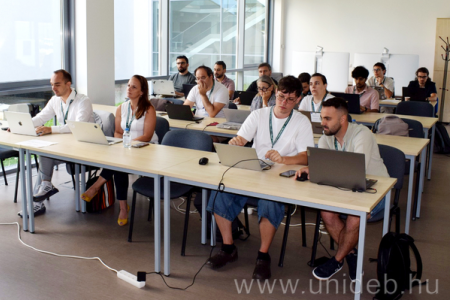
Artificial intelligence has moved from a specialist research topic to a discipline that shapes medicine, engineering, the natural sciences, and the social sciences alike. Few events illustrate this shift as clearly as the recent international symposium hosted by the Faculty of Informatics at the University of Debrecen in Hungary. The AIDA AICET 2026 event brought together researchers, faculty members, doctoral candidates, and industry representatives to examine new trends in artificial intelligence, the practical possibilities and challenges of the technology, and the growing importance of industry certifications in the field.
This article reviews what the symposium covered, why international cooperation has become essential in AI education, and what these discussions mean for students and professionals planning a career in this fast-moving area.
If you are weighing study options in artificial intelligence, request a program overview from the University of Debrecen to see how its curriculum addresses the themes discussed below.
Why International Cooperation Shapes Modern AI Education
Artificial intelligence develops at a pace that no single department can follow alone. New methods in machine learning, large language models, and agent-based systems appear month after month, and research groups that work in isolation risk falling behind both scientifically and pedagogically. This reality framed much of the discussion at the University of Debrecen symposium.
In his opening remarks, Dean András Hajdu explained that the International AI Doctoral Academy (AIDA) exists to connect universities, researchers, faculty, and students working in artificial intelligence, and to make high-level AI knowledge accessible across institutions and national borders. His message was direct: universities must share knowledge, educational resources, and expertise with one another, and they must open doors for young researchers to join an international community.
Hajdu also stressed that the aim of initiatives such as the AICET summer school is not simply to deliver AI education. The goal is to create an environment where participants learn about advanced technology, understand the scientific principles behind new developments, and gain practical experience working with those technologies. That combination of theory, scientific literacy, and hands-on practice has become the benchmark for serious AI programs worldwide.
The AIDA Network and Its Mission for Doctoral Training
Among the invited speakers was Ioannis Pitas, professor at the Aristotle University of Thessaloniki and president of AIDA. He outlined the organization’s core mission: strengthening doctoral programs in artificial intelligence, sharing educational resources across member institutions, hosting high-quality academic lectures, and fostering international collaborations.
For prospective doctoral students, this model has practical consequences. Membership in a network such as AIDA means access to lectures, course materials, and supervisory expertise that extend well beyond what any one campus can offer. A PhD candidate based in Hungary can attend courses taught by leading researchers elsewhere in Europe, present work at joint events, and build the professional contacts that later shape an academic or industrial career.
Exponential Growth in AI Programs Worldwide
One of the most striking observations from the symposium concerned the speed at which AI education has expanded. Pitas noted that six years ago, there were hardly any departments or undergraduate programs specializing in artificial intelligence. By 2023, roughly 300 such programs existed worldwide. Today, that number exceeds 600.
This growth reflects enormous demand from students and employers alike. It also reveals a structural problem: because many programs were established quickly and in response to market pressure, there is still no standardized, mandatory curriculum for bachelor’s or master’s degrees in AI. Content quality and coverage can vary significantly between institutions.
To address this gap, AIDA has developed the AIDA AI curriculum, a broad collection of foundational and application-oriented courses from which universities can assemble coherent AI training programs. For students comparing options, a program that aligns with such a framework offers a useful signal of breadth and rigor.
Considering a structured path into artificial intelligence? Compare the AIDA curriculum framework with the study plans offered by the Faculty of Informatics at the University of Debrecen, and contact the admissions office to discuss which courses best match your background and career goals.
From Neural Networks to Digital Twins: What the Symposium Covered
The technical program at AIDA AICET 2026 was deliberately wide, reflecting the range of problems that artificial intelligence now addresses. Presentations included:
- The potential of decentralized deep neural network (DNN) architectures for analyzing visual data
- Practical experience with computer vision models used in security and surveillance
- Results of 3D animation of the human face and body
- The use of generative AI in the workplace
- Professional communication about technology and its role in digital marketing
- Current challenges in autonomous driving
- Trends in digital twins and integrated modeling for climate and air quality applications
- Environmental applications of artificial intelligence
- The development of autonomous AI applications
The variety matters. It shows that AI is no longer confined to computer science departments. Climate scientists use integrated models to forecast air quality, marketing teams apply generative tools to campaign work, and security professionals deploy visual recognition systems under strict operational constraints. Students who understand this breadth are better prepared to choose a specialization and to communicate their expertise across disciplines.
The Demand for Practice-Oriented Training
Speakers at the symposium repeatedly returned to one theme: both academia and industry now expect training that goes beyond fundamentals and state-of-the-art theory. They want graduates who can apply knowledge in real-world contexts, whether that means implementing a vision model in a production environment, evaluating the reliability of an autonomous system, or explaining AI-driven decisions to non-technical stakeholders.
This expectation has consequences for how universities design programs. Lectures and examinations remain important, but projects, laboratory work, industry certifications, and collaboration with companies now carry comparable weight. The University of Debrecen’s decision to pair its symposium with industrial certification exams illustrates this approach in practice.
Industry Certifications and Their Role in an AI Career
A distinctive feature of the event was the opportunity for participants to sit industrial certification exams on site. Certifications occupy a useful middle ground between academic degrees and self-directed learning. They verify specific, current competencies, such as working with particular tools, frameworks, or workflows, and they signal to employers that a candidate has invested in keeping those competencies up to date.
For students, the practical advice is straightforward. A degree provides the theoretical foundation; certifications demonstrate applied proficiency. Combining both produces a stronger profile, especially in a job market where the number of AI-related roles continues to grow faster than the supply of qualified candidates. When evaluating programs, ask which certification pathways a university supports and whether exam fees or preparation courses are integrated into the curriculum.
Not sure which credentials fit your plans? Schedule a consultation with a program advisor to identify the certifications and elective courses that best complement your intended specialization.
What the University of Debrecen’s Approach Means for Prospective Students
Hungary has become an increasingly attractive destination for international students in technical fields, supported by English-language degree programs, a competitive cost of living, and a central location within the European research landscape. The University of Debrecen’s activity in artificial intelligence strengthens that position. For anyone considering AI studies in Central Europe, several lessons emerge from the symposium:
- Look for international integration. Programs connected to networks such as AIDA give students access to shared courses, guest lectures, and research communities beyond the home campus.
- Prioritize applied experience. Ask how much laboratory work, project-based learning, and industry collaboration a program includes. The demand for practice-oriented graduates is explicit and growing.
- Check curriculum structure. In a field without mandatory standards, a curriculum built on a recognized framework, such as the AIDA AI curriculum, offers a measure of quality assurance.
- Plan for certification. Determine early which industry exams align with your goals and whether the university facilitates them.
Events such as AIDA AICET 2026 also serve an informational purpose for applicants. They reveal which topics a faculty considers important, which partners it works with, and how its researchers position themselves within the international community. Reading symposium programs and attending public lectures before applying is a low-cost way to judge whether a department’s focus matches your interests.
Ready to explore your options? Review the admission requirements and application deadlines for the artificial intelligence and informatics programs at the University of Debrecen, and prepare your application materials early, as competitive programs fill quickly.
Building a Connected Future for Artificial Intelligence in Hungary and Beyond
The discussions in Debrecen point to a clear conclusion: progress in artificial intelligence education depends on openness. Universities that share curricula, host joint events, and recognize each other’s training produce better-prepared graduates than institutions working alone. Organizations such as AIDA provide the structure for that cooperation, and international symposiums such as AICET 2026 give it practical form.
For students, researchers, and professionals, the message is equally clear. Choose education that combines scientific depth with applied practice, pursue certifications that document your skills, and engage with the international community early in your studies. The field of artificial intelligence will continue to expand across every sector of science and industry, and those who build broad, connected foundations now will be best positioned to contribute to it.
Have questions about studying artificial intelligence in Hungary or about the topics covered at the symposium? Share your thoughts in the comments below, or get in touch with the Faculty of Informatics at the University of Debrecen to learn more about its research and teaching activities.