
Secure a Competitive Edge in IT Security: University of Debrecen Student Wins World Championship
How the University of Debrecen Prepares Computer Science Students for Global Success
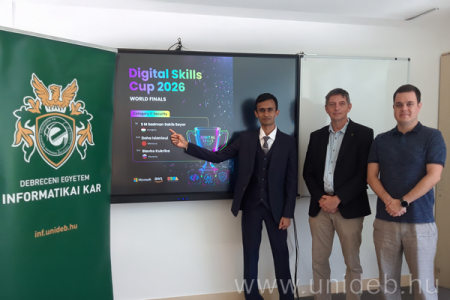
Achieving a World Championship title in any discipline requires a combination of rigorous preparation, high-level instruction, and practical application. Recently, the global technology community saw this combination unfold when a senior BSc student from the University of Debrecen claimed first place in the IT Security category at the Digital Skills Cup. This global online competition, coordinated by industry giants Microsoft and Amazon Web Services, attracted more than 4,300 participants from 64 countries. Out of 959 competitors specifically in the cybersecurity track, S M Sadman Sakib Sayor, a Computer Science and Software Engineering student at the Faculty of Informatics, emerged victorious.
This achievement is not an isolated incident but rather a direct reflection of the educational framework at the University of Debrecen. By integrating internationally recognized certification training into its standard academic curriculum, the institution ensures that its graduates are not just theoretically proficient, but practically capable of competing on the world stage. For prospective students looking to enter the field of cybersecurity, understanding how this university in Hungary structures its programs provides a clear blueprint for what to look for in a computer science education.
The Structure and Stakes of the Digital Skills Cup
To appreciate the magnitude of this World Championship victory, it is necessary to understand the structure of the Digital Skills Cup. Organized by the Leading Learning Partner Association—a consortium of renowned international training centers—the competition is designed to test the actual, applied digital skills of professionals and students alike. The event features four primary categories: user-level artificial intelligence, expert-level artificial intelligence, IT Security (cybersecurity), and IT Developer (software development).
The competition operates on a multi-tiered elimination format. Participants must first succeed in rigorous national and regional competitions. Only the winners of these preliminary rounds earn the right to advance to the international world finals. Competing against regional champions from dozens of countries means that by the time a participant reaches the final round, they are facing a highly qualified, elite field of competitors. Winning at this level proves that a student’s knowledge is not confined to passing local university exams; it meets and exceeds global industry standards.
The Critical Role of Industry Certifications in Computer Science Education
A defining factor in this World Championship success was the student’s prior completion of the ITS Cybersecurity preparatory course and the subsequent acquisition of the internationally recognized Certiport ITS Cybersecurity industry certification. In the modern technology landscape, a university degree alone is often insufficient to guarantee employability or competitive readiness. Employers increasingly rely on vendor-neutral and vendor-specific industry certifications as a reliable metric of a candidate’s practical skills.
The University of Debrecen recognizes this shift in market expectations. By operating as a Certiport partner, the Faculty of Informatics has established an on-campus exam center. This strategic decision removes barriers for students, allowing them to prepare for and take internationally recognized professional exams without leaving the university premises. The curriculum directly supports these certifications, ensuring that the time spent studying for an industry credential also counts toward academic progress.
As noted by the student himself, the opportunity to earn these credentials was a primary factor in his decision to study in Hungary. In his home country of Bangladesh, access to such integrated certification pathways is highly limited. The ability to earn credentials that serve as credible, globally recognized proof of competency is a massive advantage for international students seeking to build a career in Europe or elsewhere.
Why Certiport Certifications Matter
Certiport certifications are not merely participation trophies; they require a deep understanding of practical concepts. The ITS Cybersecurity certification, for example, validates foundational knowledge in security concepts, network security, access control, and basic cryptography. Preparing for this exam forces students to engage with real-world scenarios rather than abstract theories. When a student enters a high-stakes competition like the Digital Skills Cup, the critical thinking and problem-solving skills developed during certification training become their primary tools for success.
Building a Practical Foundation in IT Security
The field of IT security demands constant vigilance and an ability to adapt to rapidly evolving threats. Traditional lecture-based learning often falls short in preparing students for the dynamic nature of cybersecurity. The University of Debrecen addresses this by ensuring its computer science programs emphasize practical application. According to Ákos Szabó, the developer of the ITS Cybersecurity preparatory course at the university, the student’s World Championship title clearly demonstrates the practical value of the faculty’s program.
The goal of the Faculty of Informatics is to provide students with up-to-date knowledge that directly aligns with market expectations. This means moving beyond textbook exercises to utilize the same tools, platforms, and methodologies that professionals use in the field. When students are tested on these practical skills in an international competitive environment, they perform well because their training environment accurately mirrors the professional one. The curriculum is constantly adjusted to reflect the current threat landscape, ensuring that graduates are prepared to handle contemporary security challenges from day one.
Why International Students Choose Hungary for Technology Degrees
The story of this World Championship title also highlights the broader trend of international students choosing Hungary as a destination for technology education. Hungary offers a unique value proposition for students from regions like South Asia, the Middle East, and Africa. Institutions like the University of Debrecen provide high-quality, English-language education in a central European location, often at a more accessible cost compared to universities in Western Europe or North America.
Furthermore, Hungarian universities have increasingly focused on internationalization. By incorporating international educational trends, topics, and assessment methods into their faculties, they ensure that domestic and international students alike are exposed to global standards. This global perspective enhances the agility and mobility of graduates. A student who earns a degree and industry certifications in Hungary is well-positioned to seek employment anywhere in the European Union or return to their home country with a highly competitive resume.
Integrating Global Standards into the University Curriculum
András Hajdu, Dean of the Faculty of Information Technology at the University of Debrecen, emphasized that incorporating international standards has been a key priority for the faculty over the past three years. This is not simply about teaching the same material in English; it is about fundamentally changing how student performance is evaluated and how professional ecosystems are built within the university.
By integrating international assessment and reporting methods, students encounter the exact types of evaluations they will face in the global job market. This reduces the transition shock that many graduates experience when moving from academia to the professional world. Additionally, aligning with international standards ensures that research, development, and innovation opportunities are strongly represented in the faculty’s ecosystem. Students are encouraged to view their coursework not as a series of isolated tasks, but as stepping stones toward market-ready innovations.
This holistic approach—combining rigorous academics, mandatory industry certifications, and exposure to international competition frameworks—is what ultimately leads to outstanding results like a World Championship title. It proves that talent and hard work, when supported by a state-of-the-art professional training environment, yield measurable, global success.
Key Takeaways for Aspiring Cybersecurity Professionals
For prospective students evaluating computer science programs, the World Championship achievement at the University of Debrecen offers several actionable lessons:
- Seek out integrated certification pathways: Choose programs that explicitly prepare you for and provide access to industry-recognized certifications (such as those from Certiport, CompTIA, or Cisco) during your studies.
- Test your skills in competitive environments: Participate in hackathons, coding competitions, and global challenges like the Digital Skills Cup. These events expose you to different problem-solving approaches and add significant prestige to your professional profile.
- Evaluate the university’s industry connections: A university that partners with global tech leaders (like Microsoft and AWS) is more likely to offer a curriculum that reflects current industry needs.
- Consider the international mobility of your degree: Earning a degree in a country like Hungary, within a program aligned with global standards, provides significant flexibility for your future career path.
Final Thoughts on Achieving Excellence in Computer Science
Winning a World Championship in IT Security is a remarkable individual achievement, but it is also a powerful case study in effective educational design. The University of Debrecen has demonstrated that by strategically aligning its computer science curriculum with international industry standards, providing on-campus access to global certification exams, and fostering a competitive, practical learning environment, it can produce graduates who rival the best in the world. For students serious about making an immediate impact in the fields of computer science and IT security, choosing an institution that actively bridges the gap between academic theory and professional practice is the most critical decision they will make.
Submit your application today to explore computer science programs that prioritize practical, industry-recognized skills.
Schedule a free consultation to learn more about the IT security curriculum and certification pathways available.
Explore our related articles for further reading on the advantages of studying technology in Hungary.