How Two International Students Built a Life and Career Through the University of Pécs in Hungary
Why the University of Pécs Attracts International Students From Across the Globe
Choosing where to pursue a degree abroad is one of the most consequential decisions a student can make. Beyond academics, the city, the community, and the overall environment shape not only professional trajectories but personal lives in ways that are often impossible to predict. The University of Pécs in Hungary has long been a destination for students seeking a high-quality European education in a city that balances historical charm with a genuinely international atmosphere. For many who arrive on its campus, Pécs becomes far more than a temporary stop on an academic route — it becomes the place where significant life chapters begin.
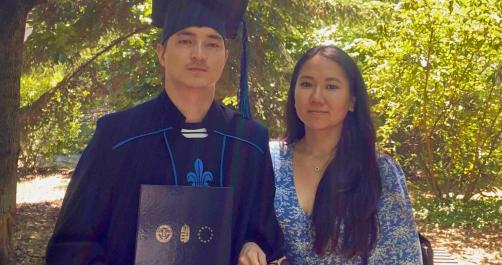
Consider the story of Yeldos Mukanov and Diana Amangeldi. Both arrived from Kazakhstan with entirely separate academic goals, enrolled in different faculties, and built distinct routines. Neither expected that their time in Hungary would eventually connect their lives in such a permanent way. Their experience offers a meaningful lens through which to understand what the University of Pécs offers beyond its curriculum: a setting where international students can thrive academically, socially, and personally.
Submit your application today to begin exploring what the University of Pécs can offer you.
Academic Paths That Lead to International Careers
Yeldos, who grew up in Central Kazakhstan, chose to study Earth Sciences with a focus on Geology at the University of Pécs. Today, he works on exploration projects in the Chu Sarysu basin in Southern Kazakhstan through a joint venture between Pallas Resources and Ivanhoe Mines. His career trajectory demonstrates the kind of professional mobility that a European degree can facilitate. The geological knowledge and field research skills he developed in Pécs translated directly into work in resource exploration — a field that demands both technical competence and the ability to operate in complex, cross-border project environments.
Diana, originally from Karaganda, pursued a Master’s degree in Computer Science Engineering. She now works as a Data Analyst at an international IT company. Her path reflects a broader trend in the technology sector, where employers increasingly value candidates who combine strong technical foundations with experience working alongside people from diverse cultural and professional backgrounds.
What both careers illustrate is that the University of Pécs does not simply prepare students to pass exams. It equips them with the analytical rigor, project management habits, and cross-cultural communication skills that international employers consistently seek. For students evaluating whether a degree from Hungary can compete on the global job market, these outcomes provide a concrete answer.
Developing Discipline Through Demanding Coursework
Yeldos has described his academic experience at the University of Pécs as demanding rather than effortless. The coursework required him to develop structured study habits, learn to plan effectively, and follow through on long-term academic goals. As he put it, the university taught him how to set a goal, make a plan, and act — a skill set that proved essential when he transitioned into professional exploration work where project timelines and resource allocation require the same kind of disciplined thinking.
For students considering rigorous programs in the sciences or engineering, it is worth understanding that the difficulty of the work is itself part of the preparation. The habits formed during challenging semesters become the operational framework for professional life afterward.
The Social Fabric of Pécs: What International Students Actually Experience
Academics, however, represent only one dimension of the study abroad experience. Both Yeldos and Diana recall their first days in Pécs with striking clarity, and their memories center not on classrooms but on the feeling of arriving in a place that felt immediately welcoming despite being thousands of kilometers from home.
Yeldos remembers meeting classmates from different continents on his very first day — many of whom became lifelong friends. He still names them specifically: Santiago from Mexico, Ahmed from Egypt, Haris from Greece. These are not casual acquaintances but people who shared formative years in a foreign city, and the bonds formed in that context tend to endure well beyond graduation.
Diana arrived in a city she describes as calm, beautiful, and full of character. For someone adjusting to a new country, the atmosphere of the city itself matters enormously. Pécs offers a pace of life that allows international students to settle in without the overwhelming intensity of larger European capitals, while still providing enough cultural activity, dining, and social infrastructure to keep life engaging.
Student Life Beyond the Lecture Hall
Both Yeldos and Diana participated actively in the social ecosystem around the university. Yeldos spent time hiking in the nearby Mecsek hills, meeting friends on Király Street — one of the main pedestrian arteries in the city center — participating in country presentations, and even contributing to a book project. These activities might seem peripheral to a degree in Geology, but they built the social confidence and cultural literacy that professionals need when working in international teams.
Diana engaged through ESN (Erasmus Student Network) events, country presentations, city festivals, and trips across Hungary. For her, these experiences were not distractions from her Master’s program but complementary elements of an education that extends beyond technical knowledge. Learning to organize events, navigate group dynamics with people from different cultural norms, and present her own culture to others — these are competencies that do not appear on a transcript but deeply influence career trajectory.
Language, Adaptation, and Unexpected Connections
One of the most practical challenges for any international student in Hungary is the language. Diana recalls that at first, she could not understand anything — street signs, shop names, everyday words all felt completely unfamiliar. However, after enrolling in Hungarian language courses offered by the university, she discovered something unexpected: certain Hungarian words sounded strangely familiar because of linguistic similarities with Kazakh. This connection, however modest, made the process of adaptation feel less isolating.
The University of Pécs provides structured language support precisely because the administration understands that linguistic comfort is closely tied to both academic performance and personal well-being. For prospective students, this is a practical consideration worth factoring into decision-making. A university that invests in language integration signals that it takes the experience of international students seriously.
Schedule a free consultation to learn more about language support and student services at the University of Pécs.
How Study Abroad Experiences Shape Professional Competencies
When Yeldos and Diana reflect on what they carried from Pécs into their current careers, the answers extend well beyond subject-matter expertise. Yeldos credits the university with helping him become more independent and confident, pointing to the professors who supported him during his studies as key influences. Independence and confidence are not abstract qualities in a professional context — they determine whether a young graduate can advocate for their ideas, manage ambiguity, and take initiative in environments where no one will provide step-by-step instructions.
Diana emphasizes that beyond technical knowledge, the university taught her research skills, planning methodology, and something she considers equally important: the ability to communicate and collaborate with people from different backgrounds. In her current role as a Data Analyst at an international company, she works on projects that require coordination across teams and time zones. The interpersonal skills she developed in Pécs are not supplementary to her technical abilities — they are what allow those technical abilities to generate real impact.
For prospective students evaluating the return on investment of a degree abroad, these testimonials offer a useful framework. The value of international education is not limited to the credential itself. It lies in the combination of technical training, cultural exposure, and personal development that together produce professionals capable of operating effectively in globalized work environments.
Pécs Family Stories: When a University Becomes the Foundation for Something Larger
The most distinctive element of Yeldos and Diana’s story is not their individual achievements but the way their paths converged. Diana was already a second-year student when Yeldos reached out online looking for advice about studying and living in Pécs. What began as a practical exchange of information led to an unexpected coincidence: they ended up on the same flight from Astana to Budapest. As they describe it, the rest is history.
Studying abroad together brought them closer through shared experiences that few other contexts could replicate: adapting simultaneously to a new country, navigating the uncertainties of life far from home, traveling through Europe, and building a partnership while still completing their degrees. Today, they look back not only as alumni but as partners and parents. Their reflection — that Pécs is where their family was born — captures something that university marketing materials rarely articulate: the possibility that a study abroad experience might reshape the most fundamental aspects of a person’s life.
They plan to bring their son back to Pécs when he is older, to show him the city where their journey began. For a university, this kind of multigenerational connection represents the deepest form of alumni engagement — one that no strategic plan can manufacture but that a genuinely welcoming environment can facilitate.
Have questions? Write to us! We are happy to help you understand what life in Pécs might look like for you.
Practical Considerations for Prospective International Students
For students currently weighing their options, several practical factors about the University of Pécs deserve attention. The cost of living in Pécs is significantly lower than in Western European university cities, which directly affects the quality of daily life — the ability to afford proper housing, eat well, participate in social activities, and travel without constant financial pressure. Housing options are available through the university’s dormitory system as well as the private rental market, and the university provides guidance for incoming students navigating these arrangements.
The city’s size works to the advantage of international students. Pécs is large enough to offer a rich cultural scene — museums, theaters, galleries, and a well-known Christmas market that Diana still remembers for its spices, mulled wine, and kürtőskalács — but small enough that students can develop a genuine sense of familiarity with their surroundings. This balance reduces the disorientation that many international students experience in larger, more anonymous cities.
Health insurance requirements, immigration procedures, and logistical details like getting to Pécs from Budapest are all addressed through the university’s admission and preparation resources. The institution has clearly invested in making the transition as smooth as possible, recognizing that administrative friction in the early weeks can undermine the entire experience.
Making the Decision: What Future Students Should Take Away
Yeldos and Diana’s message to students considering the University of Pécs is straightforward: take the step. Their own story demonstrates that the consequences of studying abroad extend far beyond what any applicant can anticipate at the time of application. A degree program that seems primarily academic can become the context for friendships, professional networks, language acquisition, personal growth, and even life partnerships that define the decades that follow.
This does not mean that every international student will find their future partner in Pécs. But it does illustrate a broader principle: environments matter. A university that fosters genuine international community, provides robust academic training, supports student well-being, and sits within a city that rewards exploration creates conditions where unexpected and valuable outcomes become possible.
For students from Kazakhstan, other Central Asian countries, or anywhere in the world, the University of Pécs offers a specific combination that is difficult to find elsewhere: a historic European university with modern facilities, a genuinely international student body, a manageable cost of living, and a city that feels like a place to live rather than merely a place to study.
Explore our related articles for further reading about student experiences, academic programs, and life in Hungary.
Final Reflections on the International Student Journey
The study abroad experience is often discussed in terms of academic rankings, tuition costs, and post-graduation employment statistics. These metrics matter, but they capture only a fraction of what actually happens when a student relocates to a new country for several years. The friendships formed in dormitories and lecture halls, the confidence built through navigating an unfamiliar city, the professional skills developed through collaboration with peers from dozens of countries — these are the outcomes that shape careers and lives over the long term.
Yeldos and Diana’s story is one of many Pécs family stories that illustrate this reality. They arrived as individuals with separate goals and departed as partners with a shared history rooted in a specific place. The University of Pécs provided the structure — the academic programs, the student services, the social infrastructure — but the life they built there was ultimately their own creation.
For anyone reading this who is on the fence about applying, the practical next step is simple: research the programs that align with your academic and professional goals, review the admission requirements, and reach out to the university’s international team with your questions. The information you need is available. What cannot be predicted is what will happen after you arrive — and that, as Yeldos and Diana would be the first to confirm, is precisely the point.
Share your experiences in the comments below if you have studied abroad or are considering it — your perspective might help another student make their decision.