
Examine Prof. Daoyi Dong’s IEEE Distinguished Lecture at Óbuda University on Artificial Intelligence
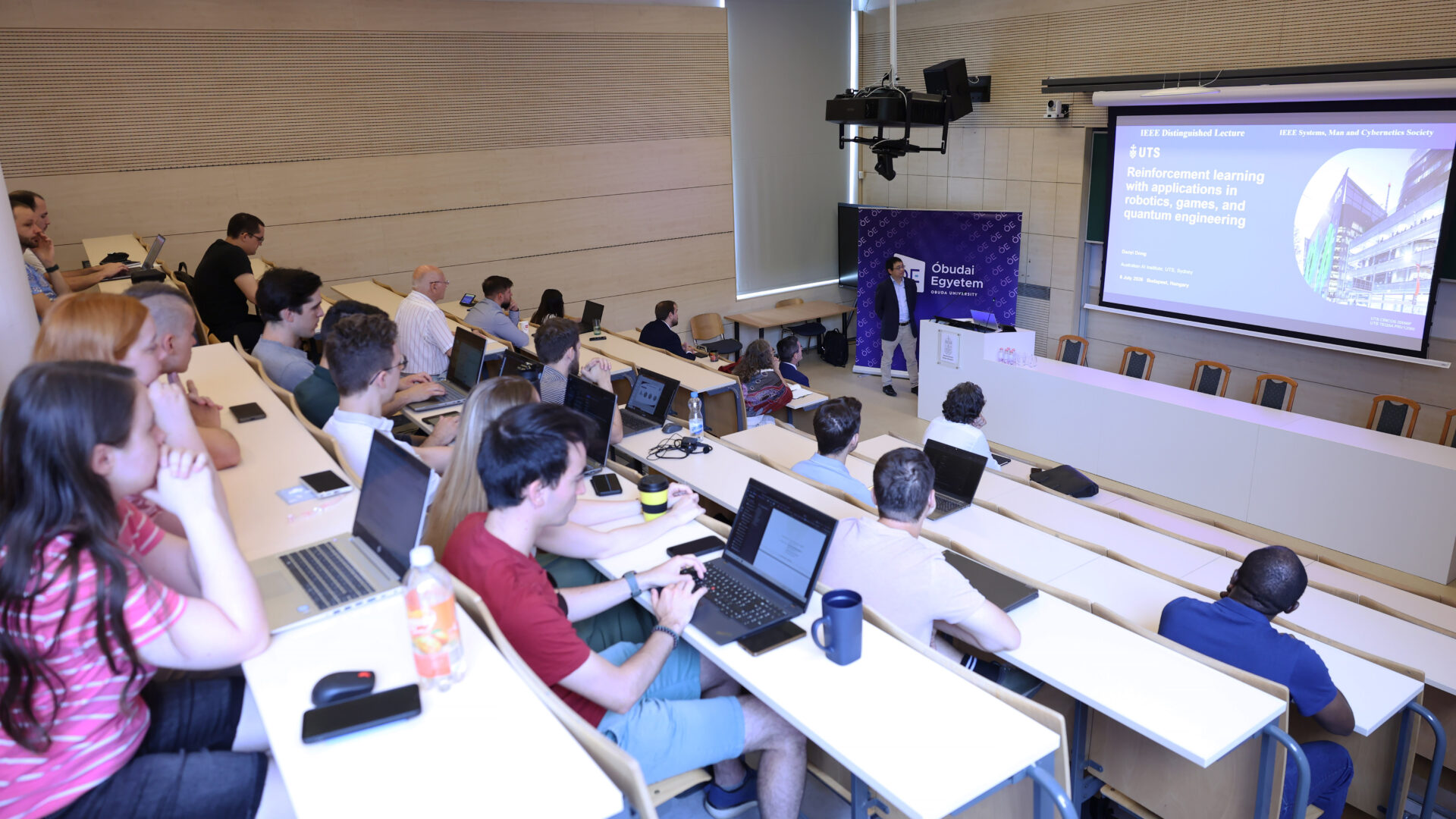
Attending lectures by globally recognized researchers provides aspiring engineers and technologists with a distinct advantage in understanding the trajectory of modern science. Recently, Óbuda University in Hungary reinforced its commitment to advanced technical education by hosting an IEEE Distinguished Lecture featuring Prof. Daoyi Dong. This event, organized by the Hungarian Chapter of the IEEE Systems, Man, and Cybernetics Society, highlighted critical advancements in artificial intelligence, quantum engineering, and reinforcement learning.
Connect with Leading Researchers at Óbuda University in Hungary
Choosing a university that actively facilitates interactions with world-class scientists is a strategic decision for any student. During the event, Prof. Dr. Levente Kovács, Rector of Óbuda University, emphasized the institutional priority of connecting students, researchers, and industrial partners directly with leading experts. The goal is to provide first-hand insights into the latest research directions in artificial intelligence, robotics, and quantum technologies.
These academic encounters do more than simply transfer knowledge; they serve as a catalyst for inspiration and lay the groundwork for new international research collaborations. For prospective students evaluating engineering programs in Central Europe, the ability to attend events of this caliber demonstrates the active, research-intensive environment maintained at Óbuda University. Schedule a free consultation to learn more about how you can participate in these academic networks.
Understand the Expertise of Prof. Daoyi Dong in Artificial Intelligence
The caliber of a university’s guest speakers often reflects the strength of its own academic departments. Prof. Daoyi Dong is an IEEE Fellow and a Professor at the University of Technology Sydney (UTS), as well as an ARC Future Fellow. His academic trajectory includes prestigious professorial and associate professorial roles at the Australian National University (ANU) and the University of New South Wales (UNSW). Furthermore, his experience as a visiting researcher at elite institutions such as Princeton University and RIKEN underscores a deeply rooted, international research background.
Prof. Dong’s primary research areas sit at the intersection of classical computing and next-generation technologies. His work focuses heavily on machine learning, quantum control, system identification, and renewable energy systems. The depth of his contributions to the scientific community is measurable: he has authored more than 150 articles in leading scientific journals. Notably, over 50 of these papers have been published in IEEE Transactions journals, which represent some of the most rigorously peer-reviewed and highly cited publications in electrical engineering and computer science. He has also contributed to over 60 conference publications, sharing his findings directly with the global engineering community.
Review the Role of IEEE Distinguished Lectures in Academic Growth
To fully appreciate the significance of this event, it helps to understand what an IEEE Distinguished Lecture entails. The Institute of Electrical and Electronics Engineers (IEEE) is the world’s largest technical professional organization. A Distinguished Lecture is not a standard academic seminar; it is a highly curated presentation delivered by experts who have achieved recognized, exceptional standing in their specific fields.
The Hungarian Chapter of the IEEE Systems, Man, and Cybernetics Society organized this specific lecture. This society focuses on the integration of systems theory, cybernetics, and human-machine interactions—fields that are increasingly relevant as artificial intelligence becomes more embedded in daily life. When a university hosts an IEEE Distinguished Lecture, it signals to the academic and industrial community that its programs are aligned with global standards and cutting-edge technological developments. Students who attend these lectures gain exposure to complex theoretical frameworks and practical engineering challenges long before they enter the workforce. Explore our related articles for further reading on how professional societies shape engineering education.
Explore Quantum Control and Machine Learning Applications
A significant portion of Prof. Dong’s lecture and broader research portfolio addresses the convergence of artificial intelligence and quantum control. Quantum control involves manipulating quantum systems—such as atoms, photons, or quantum bits (qubits)—using external forces like laser pulses or magnetic fields. As quantum computing moves from theoretical physics into practical engineering, controlling these fragile systems accurately becomes a paramount challenge.
This is where machine learning, particularly reinforcement learning, becomes essential. Reinforcement learning is a type of machine learning where an agent learns to make decisions by performing actions and receiving rewards or penalties. Prof. Dong applies these algorithms to optimize the control of quantum systems, helping to reduce errors and improve the stability of quantum operations. Additionally, his work in system identification—building mathematical models of dynamic systems from data—is crucial for renewable energy systems, where environmental variables fluctuate constantly. Understanding these specific intersections of AI and physics provides engineering students with a highly specialized and sought-after skill set.
Assess the Research Environment at Óbuda University
Hosting an expert of Prof. Dong’s stature is a direct reflection of the research infrastructure at Óbuda University. The institution has heavily invested in becoming a hub for advanced technological research in Hungary. This is evident through initiatives like the AI Campus, which serves as a dedicated focal point for artificial intelligence research, development, and application.
Beyond individual lectures, Óbuda University consistently hosts major international conferences. For example, the university recently hosted the IEEE 30th Jubilee International Conference on Intelligent Engineering Systems (INES 2026). A university that acts as the venue for such high-level international symposiums provides its students and faculty with continuous exposure to global research trends. The presence of active research centers, innovation parks, and venture capital initiatives connected to the university ensures that theoretical research discussed in lectures can be tested and developed into practical, market-ready solutions. Submit your application today to join a university that prioritizes active research and innovation.
Build International Collaborations Through Scientific Events
As Rector Kovács noted, events like the IEEE Distinguished Lecture create the foundations for new international collaborations. In the modern academic and industrial landscape, research is rarely conducted in isolation. Developing quantum technologies or advanced artificial intelligence systems requires multinational teams, shared datasets, and collaborative funding.
When international authorities like Prof. Dong—whose career spans Australia, Germany, Asia, and the United States—visit Óbuda University, they establish relational ties with the local faculty. These relationships often evolve into joint research grants, student exchange agreements, and co-authored publications. For a student, this means that studying at a well-connected university can open doors to international internships, collaborative master’s or doctoral projects, and access to a global network of professionals. The ability to work across cultures and borders is just as critical as technical proficiency in the modern engineering sector.
Identify Career Paths in Artificial Intelligence and Quantum Engineering
For students and early-career professionals, understanding the topics presented by Prof. Dong provides a clear map of emerging career paths. The demand for experts in reinforcement learning is expanding beyond academic research into industries such as logistics, finance, and autonomous vehicle development. Companies need professionals who can design algorithms that learn optimal strategies in complex, uncertain environments.
Simultaneously, the quantum engineering sector is poised for significant growth. As governments and tech giants invest billions into quantum computing, there is an escalating need for engineers who understand both quantum mechanics and machine learning. Graduates who possess a foundational understanding of quantum control, system identification, and AI-driven optimization will find themselves highly competitive in the job market. They will be equipped to take on roles in quantum hardware development, algorithm design, and the integration of quantum solutions with classical renewable energy grids.
Plan Your Academic Future in Technology
Selecting the right academic institution requires looking beyond standard rankings and curriculum outlines. It requires examining the actual scientific discourse happening on campus. The fact that Óbuda University regularly facilitates high-level discussions on artificial intelligence, quantum control, and cybernetics demonstrates a forward-thinking approach to education. Students are not merely learning from textbooks; they are learning in an environment where the textbooks are actively being written by visiting experts and resident faculty alike.
Studying in Hungary also offers a strategic geographic advantage. Budapest serves as a growing tech hub in Europe, with a vibrant startup ecosystem and a lower cost of living compared to many Western European capitals, making it an attractive destination for international students seeking high-quality, affordable technical education.
Take the Next Step in Your Research Career
Engaging with the work of international IEEE Fellows like Prof. Daoyi Dong provides a benchmark for what is possible in the fields of artificial intelligence and quantum engineering. Whether you are a prospective undergraduate, a master’s student looking for a research-focused program, or a professional seeking to upgrade your skills, aligning yourself with an institution that prioritizes these connections is a practical step toward a successful career. Have questions? Write to us! to find out how you can become part of a dynamic, research-led academic community in Hungary.